Friday, 10 January 2014

The Cycle of Civilization and the Emperor's New Clothes


As a young African in Europe, eager to use this exposure to the best cultural centres on this planet to know the ways of this world, I took to reading a lot. Exposure to the writings of Nietzsche never gave me the feeling of meeting a like spirit, even if I discovered that I ponder much the same thoughts as he does, in much the same way that he does. 
 
Friedrich Nietzsche

Rather, bossed around and belittled in menial labour environments, condescended upon and ignored by fellow university students, experiences that are not unique to me, discovery that my very thoughts, to the last line, were in the writings of the man those who were prone to look down upon my intellectual capacities held in high regard, thoughts I knew they could not produce as easily as I could, gave me a kind of justified pride, allowed me to see the truth behind this superiority. I realised from this discovery that I was just as good as anybody else, no matter what race, and even better in many cases, as successes inside and outside classroom environments were to prove, making me very unpopular, further proof that I was simply the victim of stereotyping and institutionalised racism, that the cumulative effect of this over the centuries was to blame for the backwardness with which my people are so readily associated. 

Due to this arrangement, it is easy for any African to develop a complex, to start believing that the treatment we get in foreign climes is justified. Evidence of our lesser capacities is overwhelming. Our continent is lagging behind in many spheres of life. I know I speak for many when I say that even some descendants of Africans who came to the new world as slaves are prone to give the impression that they are better than Africans. 

Some even go to the sad extent of intimating they had been singled out by slave traders because of this, even if this is a direct admission of inferiority by placing this capacity in the hands of slave traders, forgetting the vastness of the continent, and the fact that those who pierced their ears and lips and put large, unsightly plates in them to prevent singling out by the slave traders are not the most attractive, most intelligent people on the continent today without these plates. 

African With a Nose Plate

Rather than look to slave traders for the truth about my people, I am prone to trust my own judgement, and this tells me that there is still no black country or group that has done well in our time because they are better. We all have a place reserved for us in this system, and this fact is not always evident, until push comes to shove. 

Rather than fight the stereotyping, already wise enough to know that this would eventually make me hate my own kind, I went on a wider search for like-minded people, and found an abundant collection of such names just waiting to be discovered, and mostly titled for easy disclosure. Along the way I came upon the likes of Addison Gayle Jr. In his writings I saw my own self reflected, and if we read in order to know that we are not alone, then reading his books, for example "The Ways of the New World", as opposed to the former author, was exactly this for me. Extensive bibliographies and voluminous references led me to others with whom the same was experienced, from the blunt irony of Chinua Achebe's works to the surgical precision of Franz Fanon's philosophy; from the vision of Sheik Anta Diop to the realism of Lekan Are, and since then, I have never feared loneliness. 

Exposure to like minds can create paranoia when the things that you suspected about the world become suddenly confirmed by men who are like you and have been there already, and lately, these fears have begun to turn from mere words into reality. 

I have made real an old discovery that I am an artist by taking to a career of writing. General public response to my "art for the people's sake" has been favourable. Previously, these responses were restricted to the post, e-mails and commentary columns. But lately, I have noticed a new trend towards direct reactions by people I come across on the streets, usually directly connected with an article that just received major publishing, or a book I am working on.
A few negative remarks, I can take. Even reminders of where I am and some warnings to keep out of this or that country's business are to be expected. A "high school head" wondering what text books I read, as opposed to just books, is simply one of those things. Unexpected, though, has been the rate, the numbers who suddenly seem to be hooked up to efficient networks, and the speed of delivery and distribution of my personal pieces of work. 

Seen from a creative point of view, this has begun to bear all the hallmarks of intellectual and creative bankruptcy on the part of my self designated opponents as the cause for this impasse. In a line, I am suddenly getting the feeling of one who is on a bus full of down patients who keep saying "hello" throughout the trip (no offense intended). This is definitely going nowhere, especially since an element of force is involved. I feel that I am getting forced to reject the ultimate: my own self. 

If I relied on my eyes alone, then I would not believe that this is happening. These things belong to the past. Evidence of a world that has changed is there for all to see. I may even place the blame on myself, and believe that I am the most imperfect person in my neighbourhood, hence the fame, or shrug. This scenario is thankfully not beyond my imagination, and prevents me from falling into the shoes of those who are quick to say that these things belong to the past. There is evidently a double standard at work in the world today. As an African conscious of who I am and where I stand in this struggle, of my roots and the history of the violent meeting of the Afro and the Euro worlds, of the fear that rules this world, seeing why this level of caution is necessary is easy. The technology available to anyone today also makes the fast delivery and close scrutiny possible. 

This personal exposure to what has been a common experience, and recent world economic and political developments, and a simple "one plus one" on my part, has made me see the verity in the words of many radical authors and activists from the past, and regret the fact that I had not espoused their thoughts earlier on. This would have prevented me from walking into walls.
In the shadow of the war against terrorism, of the World Trade Organisation meeting in Doha in the Gulf state of Quatar, in which many in the third world came away complaining they were getting forced to accept terms of trade that would be unfair to them, surprised the talks were not even connected to the fight against terrorism, convinced the rich countries were bent on using what has been coined "economic gunboat diplomacy" to ensure their aim of staying, and getting richer, it should become more than clear to all who have believed fair trade between countries will one day be a reality that the rich are not prepared for such an eventuality. Rather, they will do all they can to force poor countries to accept the primacy of western interests, and the prospect of further decline for the poor. Everything else is simply lip service to such a standard, no matter the garb in which this message is presented. 

The rich countries of the world want to maintain the free access they have to world resources and markets by any means available to them, and they will do all they can to ensure these channels remain available to them, even if this entails direct meddling in the domestic affairs of other countries to ensure that the regimes do not rock the boat, as is evidently the case with those governments that were actually made to recall their representatives from the last WTO round, when these were in disagreement with the rich countries' demands, when one knows that it takes two to tango; from force or threat of force when all else fails, by frustration of positive movements and people in recalcitrant countries, to actual disrespect of the intelligence of the third world by blunt evasion or obfuscation. 

Action speaks louder than words, or aid. 

We live together on this vast planet that has no corners in it, which is fast becoming smaller thanks to technology, in which no major activities can sufficiently be concealed from other human eyes. Our misery, our suffering, our starved bodies in the deserts moving to retrieve food dropped from aeroplanes, our dead bodies in ship containers as we try to better our life conditions by migration, is all too evident to the rich. They see our toil, they see our tears, they see us die in millions because of poverty, caused in large part by policies or wars their former and present designs make possible, and because of disease. They are just as human as we are, and are known to have a conscious and do show compassion when the situation arises, so what is preventing them from reacting to the mother of our tragic situation in the same way? Why, in view of all this evidence, are they still actually, actively engaged in setting the stage for a worse tomorrow for us? 

When a child, a young adult, a mafia like organization does not want to play fair, and is prone to use force to compel opponents to obey, we usually conclude that the person lacks the capacity to see options. We call such people bullies, and as we all know, bullies tend to be the least resourceful, least creative members of any given group. But what happens when a person of the above propensity happens to be surrounded by visible signs of his better intellectual and creative potentials? It then becomes difficult to place such persons under the same umbrella as any bully, even when they proceed to coerce others to do things they want them to do against their will. We tend to subconsciously regard such persons, in view of their better accomplishments, as beings more informed than the rest, that they happen to know what is good for the rest and are sometimes compelled to resort to force to correct the recalcitrant, for their own good. 

We are prone to ready acceptance of their ideas, their theories, their ways, and even become suspicious or regard those thoughts originated by our own members as mediocre. And correctly so. The exclusive ideology at the base of such a system gives us no other choice. Disagreement with this would have to lead to a conclusion that regards the shinny, impressive creations surrounding the bully as nothing more than vain products of this same bully's particular mind. If we accept such a premise, then we would also have to make real the implication that we can do as well, even better than the bully. Simply put, we are forced to accept that we are better than a person who resorts to bullying, who is always mentally inept since options are a luxury for such a mental design. 

This is a very contentious position to take, not so much because it is evidently radical, or insulting, but because it challenges the dominant, exclusive ideology at the base of the entire system itself, which is to blame for the inactivity, and also demands that we prove the assertion. Once such a premise is adopted, rather than wave placards calling for the death of the capitalist system, without a viable option, we need to look at the sacrosanct aspect of it, and by so doing expose the element within the design that is aiding the man, or preventing him from using his mental prowess to change a system that has evidently gone wrong. 

If the level of organisation, of technical advancement attained to date can say anything about the man, then it is that he is very creative. Since systems are initiated or created by man, we would be led to believe, in light of the former, if we have a basic education, are articulate and have an idea of how systems operate, that they can be deciphered by man, no matter how complex they become, and can be changed or altered by man to suit his calling. He is, after all, the creative being, the being making highly complex, convoluted and unbelievable discoveries and inventions in our time. If helping prevent the spectre of further tragedies and misery in the world, of war and famine, of destruction of our own breathing and living environment will benefit man, then why is it so hard for the man to change such an evidently self destructive orientation? What is the ingredient in this system that is preventing such evidently creative minds from making concerted efforts to change it? Since the man will not reveal the secret, we have to break the system down to its constituent parts for the answer. 

A system has an ideology at base, and relies on an accumulation of theories to substantiate this, to give it form and shape, direction, even purpose. It is in these supporting pillars that we must look for the clue. If anything, our knowledge that the system is flawed gives us a good start. We know that the theories that have flowed from it over the years are nothing more than self-serving lies. Taking the theories apart, one by one, we discover glaring truths. 

Like those who used the bible to justify slavery, and even wrote voluminous books on the subject, the system has turned science into its service industry, and used this to, for example, show the inevitability of poverty in Marcus Aurelius' theory of "one man wanting more and another getting less", which, as a natural condition, fails to account for the scale and scope of poverty in the world today, or the fact that it is not restricted to individuals, but to whole groups, amounting to subtle condoning of an unnatural condition; or the theory of population growth that compares industrial societies to hunting groups, forgetting or ignoring the fact that population growth is linked to exigencies (rain storms, war, etc.), in which people tend to increase sexual activity in an attempt to survive through numbers, a state this system excels in projecting; or Levi Bruhl's theory of the pre-logical mentality of primitive peoples who, with his head deep in the sands of African languages, could not see that the very structure of the languages he considered as pre-logical was to be found in the major European languages, including the civilized Germanic strain. 

A shrewder variant of thinkers have provided a spectre of chaos and wars if the west loses its access to world markets and resources, warning that the technology that has enabled the west to support otherwise overpopulated regions would fail, leading to chaos involving the entire world. In an equation: western consumerism and the remarkable, unnecessary mountains of waste this creates is peace, redistribution and better management of world resources is war. We are certainly in the "four legs good, two legs better" phase.
We discover that medical and social sciences have been used to medicalize whole societies for ulterior ends. For example, campaigns have been launched which have disregarded the instinctive importance that the human creature attaches to reproduction, by attacking a sexually transmitted disease in the same manner as an outbreak of other kinds of diseases, creating a negative reaction which has led to a more complicated situation of an actual drop in the number of people seeking medical examination, causing silent epidemics of other, curable sexual diseases to become commonplace, restricting discovery of such diseases to pregnant women and others who have no choice but to be in a medical institution, an outcome that does not become accidental once one realizes that the initiators of the placard waving method knew better; that, at the onset of the epidermic, a campaign fitting of a sexually transmitted disease would have prevented the scope of the epidemic today. 

Not restricting this scrutiny to present theories, we can go back much farther in time and find that science has been used to show the connection between muscular bodies, virility, athletic ability, and hedonistic, pervert, backward, lecherous, primitive desires of early man; between thatched huts, wide nostrils, smaller craniums and early man; between stone constructions and modern man. All these theories still find wide acceptance in our time, even if this is not openly stated, though proof of their self contradictory nature has been found as, for example, the discovery of larger craniums in those who were considered as precursors of modern man, or those who are poor today as opposed to the most successful groups having the exclusive right to this endowment; the discovery that in evolution, nostril size does not matter to intelligence, that the leading movements of the man have considered virility as a sign of a better race, but demonized it when seen in other races, etc. 

By reducing the past of human beings to epochs of development which fit in its design, which point to today as the apex of this development, the system has succeeded in making people believe that man is no more than the sum of his achievements to date. With such a precedent, who would try anything new. New things cannot be made today. They lie in the future of developing man, in the hands of those who lead in this development. The system has succeeded to drill us into believing, even if subconsciously, that man is on a journey that leads to something like white skin, blond hair, and blue eyes. In some countries, like Cuba, this is not a subconscious belief at all. Here, some individuals will not flinch to say that breeding with light skinned people improves the race. It is quite difficult for the more realistic among us to see the improvement that can result in changing a given black man into a given white man. But then ignorance has a way of confusing things. In this case, aided by the system's brainwashing, better is readily equated with the status that comes when one man has his own money, and another does not. 
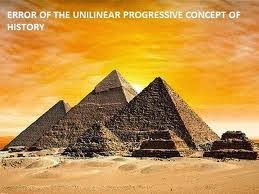

As a theory based on this one way, up the ladder approach, from primitive to the modern age, the appearance of signs of highly advanced cultures in unexpected places and times has posed a threat to the basic tenets of the system itself. This is the sole reason individuals in the system have resorted to fantastic theories, if only to keep the world brainwashed on the theory of the linear development of man, because of Knowledge of the aftermath of admittance. Gigantic people whose gigantic bones have yet to be found, aliens from another planet who chose the wrong groups to give their civilizations to, and blue-eyed strangers who did not base their civilizations in their countries of origin, but crossed the seas to place them among primitive peoples, are a few examples of the fantastic explanations used. 

At the base of these attempts is a fear of the loss of the central position enjoyed by the system's philosophy when people in other parts of the world discover that they can think as well, if better than the best who have been, that they can be just as innovative. The biggest fear is the fallout that will result when the truth about this system's cultural institutions is known and a whole range of subjects, discoveries and breakthroughs are revealed for what they really are. What is going to happen to all the books that will be revealed for the fakes that they are? What will become of all the disciplines, the institutions of learning, the whole design from the root to the fruit, when people discover that they are phonies? 

The world cannot stand up to the system because the ideology at the base of the system inculcates in all a belief that this culture is a chance occurrence which people have to hold on to with all their might, and teeth if it comes to that, lest it disappears down the abyss from which it came. This is evidently a lie, which, unfortunately, requires more proving to expose, to make a part of our psyche because, at base, all of us, from scientists to those working on Wall Street, from sociologists to those destined for the pentagon, have been bred in institutions of learning which indoctrinate us with the very system's lies, who are trained to do nothing more than help the system keep its path. To expose the lie, we have to go back to the very first period when man was in the position he is believed to be in today; the only time when this linear development was true. From this past, if we keep our eyes open and believe what we see, we will realise that believing the theory of linear, uninterrupted development is wrong, and very limiting in that it keeps us from knowing what man really is, and prevents daring ventures since people are led to believe that they have never had it this good before, to look to the bearers of this system as the ones to emulate. 

It is true that higher cultures are creations of improving beings, who start them when they are capable and ready for such levels of sophistication. This stage, however, came and went for man, a long time ago. This fact is evident in the evocations of sophisticated cultures that we are constantly getting from the past, from the great pyramids all over our planet, to the civilizations of the Nok and Bauchi plateaus in Nigeria, which actually show signs of a backward movement in development, from Timbuktu's highly advanced stores of knowledge, to the Dogon tribe telling of super dense matter. In his state today, man has had a mind capable of such high levels of sophistication for a long time. It is this mind, and its very works, that made past civilizations possible, which forms the backbone of any civilization that is, was, and will come, and not the facial features, the dwellings man lives in, or the traditions to which he resorts. 

Civilizations, or advanced cultures, comprise of two elements: the minds of the people and the products of these minds. Civilisations can only exist and flourish around standardization, a necessity for exact communication, even though this can be altered as awareness and knowledge of the need grows, whether this growth is aided by the very creations of the mind or not. Seen as such, since civilizations are merely collections of artifacts, static creations of non static minds, their development follows quite different routes to that of the minds that create them. 

Civilizations have to constantly get pulled along, so to say, to be kept in pace with the creators whose mental capacities they do not directly, or actually aid to develop. The minds, however, tend to follow a logic for developing forms of communicating and expressing that are less logic based than appealing, which has to be a natural ear for a better way because this same orientation gave man his potentials (not the other way around), a phenomenon that is quite evident today. Certain aspects of a civilization are cumulative, while others develop with time without being cumulative. If we understand this, then we can easily see why, like supply and demand in an industrial or agricultural cycle, a time will come when the two can grow apart, and another will come when new civilizations arise, as long as the human mind stays the same construction and aim. 

Creations of the minds which were novel and exciting at one time, can become vain, superfluous, counter productive, or redundant later on. A critical situation can arise when the individuals consciously find the need to divorce themselves from the culture they have created if they recognize the vanity of the whole direction, or they can simply grow out of it and move on to other, better concerns or ways of life, which do not necessarily have to bear signs of what today is considered as advanced, unless one stays brainwashed with the belief of the hierarchical structure of such evolution. Human beings in simpler times do not become primitive. They are the same beings who made past splendours, and, using history to prove my point, may even have improved and simply need to excite that core in them which makes them creative in a manner we readily recognize as civilized. 

This theory kills two birds with one stone. It not only helps make sense of the confusing landscape of vanished cultures all over the world, and why they vanished, it also exposes the bully as nothing more than a man who has gained respect and following in our age because of his extensive use of self-serving theories, placing his system at the height of human development, using the very implements that aided in his domination of the world as symbols of this advancement, not allowing the rest of mankind to realize that these are mere creations of the human mind, the only constant in the equation. 

Making statements that appeal to the conscious of the rich has over the centuries proven a futile mission, and will continue to do so, for a long time to come, as long as the vanity at the core of the system remains, as long as people do not forget to see the neat, suit clad, hesitant feet representatives of the system they address as simple pawns in it, who know nothing else save that which they have been brainwashed on, and the orders they receive, as long as people do not see that the only consolation for such men is the fact that the system is working for them. If we understand this then we will see why when things are not going their way, force becomes the only option.
As actors in a system biassed against us, as human beings whose story has yet to be told, who deserve to live better lives, it is essential to find a new, radical direction; to commence with telling our own story, even if this entails shutting the rest of the world out of this process; to remember all those times we originated ideas, and know that we gave them up because designs within the system did not permit it; to know that if we push along with our own theories, we will create new standards. 

What better way to start this than to reveal the vanity at the base of the system that keeps us in bondage, and free the minds of the poor by making them realise that they are not what the rich have led them to believe, especially when we are aware that individuals from skin clad groups have managed to come away with degrees in universities where knowing how to split an atom was a precondition, that, not more than a hundred years ago, some of the most advanced countries comprised such groups, this itself proof that, if managed properly, any society today can shine. Seen in the context of the modern world, these groups are more defenceless than primitive, and this includes more than half a billion people on this planet's poorest continent.

Pan-Africa Now or Perish


“We must unite now or perish”
~Kwame Nrumah, echoing John Hendrick Clark in a speech given at the founding of the OAU, Addis Ababa, 24 May 1963.

There has recently been a rise in seemingly orchestrated, systematic attacks on the tenets of Pan-Africanism, especially personal attacks on those of its proponents who were crucial to its development, on the continent and beyond, that take the form of inferring these individuals were misguided, or question their qualifications,  intelligence, and sometimes  sanity.

This campaign, usually spearheaded by very highly educated men, professors or lecturers at the highest institutions of learning in "developed" countries, flaunting African colors and erudition, is as pathetic and disheartening as the reality these men exist within.

Personal attacks on Pan-Africanists, with intent to discredit, are ultimately aimed at the movement itself. But then, it  shouldn't take a rocket scientist to see just why Pan-Africanism is an imperative for Africans.

Observe the incompatible mentalities formerly similar people have developed over such a short period of time, and, as if this were not enough, continental Africans are already so in the grips of artificial identities forced on them by imperialists they actually talk of their nationalities as if they were referring to race itself. A Ghanaian is not only a Ghanaian, a national of Ghana, but is a member of a race in its own right, even though we all know there is more to Ghanaians than meets the eye.

It goes without saying that African national demarcations do not reflect the ethno-cultural realities on the ground, and as such do nothing to keep the profile of their own people. Some African ethnicities form tiny minorities, completely surrounded by larger ethnicities that are more advantaged, and the needs of such tiny groups cannot be addressed. Other ethnicities are split between two, sometimes three different countries, each part forced to learn a different official language, each part considered a nationality in its own right. Sometimes, as was the case with the Germans under the cold war, movement between countries can become restricted, but usually passports are required to pass from one country to another. In most cases, power is more or less exclusively in the hands of a single ethnic group, and resentment grows. This means that, for many African people, no real identification occurs with the country in which they live, meaning the various republics are not considered "homes" in the same manner the Dutch would consider Holland their home. One doesn't need to do much thinking to realize the attitude people within the borders will have towards the entity they reside in, and also see just why there is so much wanton robbery of state coffers in high places. It is hard to imagine a man robbing a place he feels is his home in the same manner Africans in high places rob their own countries.

Keeping in mind the past and achievements of the people of this continent, what this chaotic state of affairs, and a lot of other negative activities by Africans in our day says is mental and physical degeneration has really set in, and is bound to go but one way. It reveals acceptance on our part of colonialism as the only system possible for us. We are probably in the last phase of a process that was designed by colonialists who forced cultures and identities on us, against our will, with a lot of our own blood spilt in resistance. What is more disconcerting is the fact the strongest voices against Pan-Africanism, the only movement capable of bringing order to this chaos, including the abolition of colonial borders that lie at the center of the problem, are actually African. Suffice to say how adjusted and comfortable these people are with the way things are going is both a measure of the intelligence  their academic qualifications obscure from sight; and a measure of how successful our colonizer's efforts to shove these same people, and unfortunately our entire continent into the colonial straitjacket have been, what with Africans doing the rest of the shoving themselves. This is indeed the actualization of the best dreams of the colonizing commission.

As far back as 1853, a British minister, Lord Grey, put the agenda of the colonial powers into words. "The true policy I believe to be" he said, "the formation of a regular government on the European model, so that the interference of the British authorities may be less and less required". This policy, known today as neocolonialism, was understood and observed, and on many occasions paraphrased by many colonial authorities in the colonies up till the time that the territories became independent.

A typical example of the resolve of the colonial powers, the ultimate determination to make colonialism a permanent aspect of the African continent is to be found in the works and writings of the person of Gordon Guggisberg, the governor of the Gold Coast from 1919. Believing greatly in the "imperial mother's" mission to help Africans, this governor strived tirelessly to improve the colonial system so as to make it stronger. Guggisberg, who believed the colonial system the only possible system there could be, believed, like his ancestor Lord Grey, that the goal was to make Africans take over, and run it themselves.

The documented activities of the colonial authorities aimed to strengthen colonialism, to make true the ultimate goal. Towards the period that the colonial powers were allowing Africans to form their own political organizations, the presence of colonial officers on the continent was ever on the increase, a fact that is unknown by most people in Africa today who believe European powers were reducing the numbers of such people as they handed power to the natives. The obvious aim of this exercise was to leave no stones unturned.

In the British colonies, they had more or less made sure that there could be no comebacks. They had had more than enough time to prepare for such a state. The transitional period, the actual handing over of power after an African leader had been chosen, was as a result smooth in their territories. The individuals who led the civil rights movements that fought for equal rights to begin with, were trusted. Later, when these were to show their true colors, they would be removed by whatever means necessary, as swiftly as was possible. In the French and Portuguese colonies however, the situation was quite different. Here, men whose crime was possibly charisma, intelligence or descent from the original ruling families, were thrown into jail before they had committed any crimes. Police here were instructed to shoot indiscriminately into crowds that gathered for any reason whatsoever. It is impossible to explain this madness any other way than that, given the complexity of the situation, the Portuguese and French felt they had no other option. They felt pushed against a wall. To them, the continuation of the colonial dream called for such drastic, and on the surface, frenzied measures.

The designs that grew out of this "dedicated work" are the African republics we know today, including the stultified mentalities of those who reside in these colonial divides. If Lord Grey or Gordon Guggisberg were to come back from the dead, they would immediately recognize the state of the continent as a product of their work, give or take a few flaws here and there.

Seen in this light, it becomes painfully clear the continent has lost this leg of the battle. It would be correct to say Africans have been completely outwitted. There is a pressing need for reeducation of the masses, starting with a lot of our intellectuals who feel by contributing to the final fall of Pan-Africanism they will usher in a new, prosperous era in Africa; who are solely motivated by the need to belong to something big, and are now members of this big house, and working hard to destroy its enemies, while, unbeknownst to them, in reality they've simply sold their own souls to the devil. We require to enable awareness of what is really happening, that enemies of worldwide African unity in our midst are doing nothing better than fulfilling the dreams of our enemies as we speak. We require at this juncture to look closely at the mentalities of the continent and the manner in which the continent is designed today, and prioritize the search for a solution to the borders that prevents this situation from getting worse. Because there was a lot of cultural suffocation and our identity was tampered with, what's crucial is the need to forge a new identity for our people, and this identity should by necessity "exclude" the 100 or so years we have been colonized, and the reason for this has already been made clear.

Many would argue here that an identity is an identity, no matter how convoluted the journey to the acquisition of this identity has been, that one cannot pick out certain aspects of the past, and discard others (colonialism in this case) in order to forge a new identity. Such an identity would be false, they assert. An identity is rather a taking into account of all the parts that have played a role in its creation.

Still, the various identities that Africans stick to today, and the different mentalities that have resulted, even between members of the same tribe who live in different countries, especially when these countries have different "official" languages, are illogical, and incompatible with a thinking people. They obscure our past because they were gained by denial of this, by deceit of the very people who bear the cultures and identities. The knowledge we have of who we are today excludes truths that would make us know who we really are, where we came from, so that we are unable in our time to properly project into an attainable future, a necessity to control of one's destiny.  The simple truth is our colonizers and enslavers couldn't exploit the fruits of African resources and labor if they had not affected a lobotomy on our conscious. The dirtying, denigrating and vilifying of African culture, the successful attempt to have Africans feel like making distance with these renounced ways, the replacement with other non African truths (or lies)/ways, and mostly, with nothing at all, was done to force Africans to accept inferiority, a position that aids in the exploitation of Africans since, when in the grips of this complex Africans put and accept western ways above their own, making them prone to agree to western orders, and ultimately the primacy of western interests above their own.

The identity that Africans should forge to redeem themselves from colonial chains has to do away with a colonial identity that by its very nature is designed to negate or deny real African culture, real African identity, so that we are unable to look back and embrace our real selves in the past, and know ourselves in the present.  Our identity has to be one made by our own people for the benefit of our people, after we have redeemed ourselves from the deceit we have been forced to live by, and have redesigned our societies according to an order we know reflects who the people really are, and will therefore benefit all. Africa can not become a home to Africans if the present colonial designs stay intact, if it is not redesigned by Africans to reflect the ethno-cultural realities on the ground. With this will disappear or be diminished a lot of the vices we experience in our day that bring our people down, including tribalism and corruption. As I said already, it is very hard for any man or woman to rob a place he feels is his home, and it will be impossible for there to be tribalism where ethnicities are autonomous on a federated continent where unity is understood to be mutually beneficial.

The only way to get to this state is to use the past; not as a model, but as a guide to the formation of these new identities. The goal is to stay who we are come what may, and manage our lives so that nobody can take advantage of us. This is similar to keeping track of self, and we all know what happens when an individual cannot do this. Staying who we are requires knowledge of who we are. A man who doesn't know who he is cannot know how to maintain that which he is. Oblivious to his true nature, he can go whichever way the wind blows since self-monitoring's prerequisite is "prior self knowledge". If I do not know myself, but someone else does know who I am, then I will forever stay at the other's whims. If we Africans no longer know who we are, which is clearly the case, then the clue to this we will find in our ancestors, their ways, their languages, their institutions, tracking this all the way into the present. They are, after all, this version we carry around with us. They are us at a later date, to put it awkwardly. There is nothing we have that they didn't have, no potentials we possess that were not inherent in them. Ultimately, this identity will have to be forged on a few cues.

Marcus Garvey says, "a nation with no knowledge of its history (and culture) is like a tree without roots", outlining the importance of being able to relate to the past in order to understand the present and deal with the future. A more genial way to look at it is Maurena Karenga's way: "A people will never look forward to posterity who never looked backward to their ancestors". Human societies behave much like an individual does with regards knowledge of self. They do not want to lose track of themselves because the consequences are dire. They are built like a tree rooted firmly into the earth. Descendants look backward to their past as they look forward to their future. The culture they build is based on experiences they go through as a group, on a journey of maturity much like an individual's, which is why tradition is also nothing more than a group's accumulated wisdom. Only unnatural situations can cause interference to this natural order, which happens to be the inheritance of colonialism or slavery in the case of modern day Africans. But then this goes with the territory. The point of bequeathing Africans such an inheritance is to sever this link to our past, to remove our knowledge of self so that we lose our collective mind, and, wondering the earth like fools, can be robbed much more effectively.

It is clearly evident that we are playing the game by the ground rules set by the colonizing commission, by people who have shown repeatedly they have no respect for their own selves as reflected in their willingness to change their own history as befits the moment, or advantage, as such anchoring their own image of self in a suspended reality. People who do not mind tampering with history, and as such their own identity, who knowingly cause their own society to lose track of itself, are obviously oblivious of the harm this can do to self and environment, otherwise they would not indulge in such an activity. This is to say our colonizers were as misled and brainwashed themselves as we have become under the system they created. We have accepted definitions of self set in motion in 1885 in Berlin, when men who were more concerned with human and natural resources sat down and drew squares on a map, sharing as such the spoils of wars they knew they could win with ease, slicing the land on which my ancestors had roamed for ages like a cake. We have taken on systems of rule that are much more backward and dictatorial than much of the pluralistic systems our ancestors developed, have acquired a mentality of leadership that is a throwback to prehistory in our case, one of which is the north European Viking line of development where, very recently, the only way to get to the throne was by killing siblings, rather than  through the rules set by society, of which maternal lineage is one. This is obviously retrogression, for the rule of the jungle era, though it reared its head here and there in Africa, was a surpassed stage. The traditional idea of the role of a leader in society has also become decadent, where now he is the most pampered person on the block, and not the one who brings order to chaos, the allegorical equivalent being the intermediary between the divine and mortals.

It is crucial for us to keep in mind who we really are goes much farther back than what we have been made to think, and takes a route very different from the one found in present history books. There has never been a tribe, or race of people called Rwanda, Liberia, Malawi, Zambia, Nigeria, or Ghana, and non has so far been created for the duration that these names have been in use, and non is about to be created anytime soon. There are ruins called Zimbabwe, but, even though the people here have spent a little over a century living in this area formerly called Southern Rhodesia, the former and latter name has only made a mark on their idea of what they are in official speak, because, unlike others across the seas who readily call themselves what they also call their country, names of African countries are still felt by the people to say little, if nothing, of what they feel they are. As intimated already, a people believing they can create a prosperous existence on such a chaotic foundation are as deluded as it gets, and will end up making that final walk into the wall of time. Obviously, correction  is the first step to taking the matter of the race's survival into our hands. Let it be remembered this cannot be done regionally, since, like a disease, it has infected the entirety of our organism, the lines the colonizers drew across the continent a mask over its true face. Faults are connected throughout the system, and, to date, there has only been one ideal that has found the correct approach that constitutes the sole cure for this particular affliction. Pan-Africanism is undoubtedly it.

Monday, 5 September 2011

How far Behind the Developed World African Countries Really Are

Kenya's most prominent writer, Ngugi wa Thiong'o, Cheikh Anta Diop, the Senegalese who is often called the champion of African identity, and the less known Simon Kapwepwe, a politician in the first Zambian republic who later turned to writing, have one thing in common. Each, in his own way, figured out how far behind western nations, or the developed world, Africa really was, and knew what had to be done to "open up the minds" of Africans in a manner known of people in developed countries. These men knew Africa had to go through a rite of passage of sorts, without which setting the continent on a path to attaining its own dynamic culture, capable of standing its own in this system, was impossible.

All three men chose to write in their own mother tongue, after starting out writing in English in the case of Ngugi wa Thiong'o and Simon Kapwepwe, compiling a dictionary in his own mother tongue in the case of Cheikh Anta Diop. This need to use a local language, even when it cost them in terms of local and international exposure, provides us with an indirect clue to the step that Africa requires to take in order to be able to cope in this system. Explaining what this is from the onset is not a very good idea without first delving into issues that require comprehension for the point to sink in.

There is a misunderstanding, caused by a hangover from a period when Europeans in the main line of the study of foreign cultures saw existing native societies in the world as prototypes of their own "primitive ancestors", fossilized remains, so to speak, of stages of development that western Europe had once gone through. This was a time when cultural anthropologists and social scientists regarded the modern west as the latest point in a line of progress that was single and unilinear, on which all other people of the world could be fitted as illustrations, as it were, of western man's own past.

This euro-centric thinking has for the most part been eradicated as the west got better informed, but only for those in the main line of study and others who came accross the knowledge through research. Little has been done to change this standpoint among the common masses. It is therefore a common occurence for people to interpret time given in estimations to mean one culture is in the exact same state in which another was as many years ago. If you asked how far behind the western world Africa is, most people would say 100 years.

Social scientists who know what they are doing are estimating how long it will take to transform, for example, Africa's economic system into a likeness of the western model, rather than placing the continent on an evolutionary ladder with Europe at the top. The amount of time is usually calculated using items that differ with subject matter, the most applied of which include technology, industrialization, economic system, and culture.

Culture is unique, the odd one in this list because, when it is understood to be a comparison between shared bases of social interaction, it includes the first three items. Though it is the most used of all in this sense, it is the most inacurate and misleading. The admission has to be made culture does not easily lend itself to comparison or ranking. It may be possible to know the state of a culture, to be able to tell whether some cultural practice or trait in one is better than that in another, but problematic to apply this to the totality of the culture, unless there is an attempt to show interrelation.

It is possible to say the Zulus have better morals, but wrong to assume their whole culture is more advanced than another because it is the nurturing environment - unless one can show how other aspects are working to make the morals better, if this can be the proof the totality is better. It is even more inappropriate to estimate how many years Zulu culture is more advanced than another, if by this we mean to approximate the number of years it will take for another to catch up. Such comparison is only possible where cultures are always exact replicas that follow a set pattern of development, and some are delayed versions (prototypes) of others. Even if this was the way reality works, we would still only be able to make rough estimates and accept they could never be accurately fulfilled due to factors with the potential to delay or speed up development, attempts to include these unknown factors in the calculation notwithstanding.

The term culture can now also be used to refer to smaller segments of society, for example business culture, political culture, or to the system or mode of social provisioning. Where the system is concerned, African countries seldom have a single, or predominant one. Most countries have a combination of the tradition based, the command, and the market driven (also called free enterprise economy). This mixture of systems is a situation quite unlike Europe at any time in its history. In the west, groups advanced from one predominant system to another, for example from feudalism to capitalism or socialism. The modern African system, or even political culture, may in large part be imposed from Europe, but differs from it in many respects because of this. There is also the fact Afrca has adopted the worst aspects of capitalism. All this makes it impossible to trace the African incarnation of a western system to some period in the west's past when there is no European parallel. Talking of Africa as behind Europe by a number of years in terms of the system becomes illogical in this case because Africa just isn't in any position or place that the west has been. It is in fact hovering between semblances of cultures that have had the most influence on this continent, never really being a carbon copy of one at a past date.

Industrialization and technology are better items to use in estimating the time required for one culture to catch up, but also have their shortcomings. For example, there is always going to be a difference between how developed a group is and their potential for development if there were no inhibiting factors. I have in mind known factors working to prevent a group from doing better than they are able to with what they already have, for example unfair terms of trade, cheaper foreign products that stunt local production, poverty, and so on.

Another factor is the known paucity on funding third world governments put into Science, Technology and Innovation (STI's), compared to western countries. The most reliable approximations of STI activity are patent filings. When they are correlated to Research and Development expenditure, the worst performers internationally are also the worst spenders. According to data compiled by the World Intellectual Patent Office (WIPO) in 2006, Africa was the worst performer. With the exception of Kenya (71 patents) and the island of Madagascar (44 patents), all patent offices in African countries recorded zero filings from locals. Nigeria, Zimbabwe, Ethiopia, Chad and a few other places saw more patents filed by foreign nationals than the total from Kenya and Madagascar which, for such a big continent, is much less than underpopulated Iceland.

If it were really possible to equate standards, and it were true that Africa is at the same level of development as Europe 100 years ago, then the creativity and inventiveness Europe entered the 20th century with would be evident in Africa today. 100 years ago was the time in Europe when motorized vehicles had already been invented, when the Wright brothers had already made their first flight, when Nicolai Tesla had already filed his patent for a basic radio. This was a time when Europeans were inventing radar, when the printing press, the paper, the machine gun, had long since been invented.

The STI activity that characterized Europe 100 years ago is nowhere near that seen in Africa today. Africa could only be considered at par with Europe 100 years ago if it was assumed there are factors preventing Africa from showing its potential, such as lack of investment by African governments in Research and Development.

That fact of the matter remains it is not possible to find Africa in any developed country's past by any of the criteria mentioned before, except in fragments. There is actually something else that I have not mentioned thus far, an item we can apply to this case that will enable us to pinpoint Africa's position with regards developed countries accurately, that will also help us know what is wrong with Africa today, why the continent is performing so poorly. This item will enable insight that will take us more than two thousand years into the past, to the efforts of Socrates, Plato and the like, efforts to which Simon Kapwepwe comes very close if not equals. We will find the answer in Greece, 2000 years ago, without this implying Africa is as many years behind the west, or that it will take as much time to catch up. The hint as to what this is comes from an unlikely source.

Nobel Laureate Gumar Myrdal concluded in his major development study, Asian Drama, that institutions and attitudes are the most important factors in economic development/progress, a factor extensively illustrated in Africa. I concur wholeheartedly with him on this. Though Myrdal does not show how attitudes and institutions are related, which would have helped make the solution easier to see, we can do the math ourselves. Attitudes build institutions, and though institutions impact attitudes, they can be considered more the means rather than the end in itself. It is therefore to attitudes that we must look in order to know where in time a group is in relation no another, as well as why a given group is failing when compared to others.

There is indeed an era in western history more important than others, an era without which the creativity that characterises the western world would have been impossible. The foundations for this culture (civilization) were laid then. This happens to be the step that African has not taken, a step as prerequisite to mature entry into this western system as knowing the alphabet is a prerequisite to learning how to read, a rite of passage without which the system will remain alien. Keep in mind as we go along the undeniable reality I have already inferred above that this system, even if a mere variant, imposed on Africa through conquest, is the one the continent lives by.

.....Subscribe to the newsletter to read the complete feature and get all future articles delivered strait to your email. Click on the paypal link in the right hand column to get started....

Saturday, 3 September 2011

Playing With Fire: Ignoring or Stoking the Ever Present Portent of Inter Ethnic Violence in Africa

People in Sub-Saharan Africa are sitting on an ethnic time-bomb, and, unless it is diffused, can never rest assured the potential for inter-ethnic violence is a thing of the past. This is true for any African country where multiple ethnicities live in countries that are run as nation states - a multi-ethnic mix united in such a manner it can lay claim to a singular national identity - in which power is not, and often cannot be de-centralized.

The manner African countries are arranged, especially regarding efforts that go into blinding people to the truth, reminds one of the film "Men in Black" in which those who are not on the inside and have seen an alien get their memory erased. The gadget in the film is very effective and, apart from memory, leaves no other side effects. In this real life example, however, the methods employed always work against the good of everybody. It results in unbelievably hateful and violent dispositions, and a general, intense malaise that takes away the creative force of the group. The harm is permanent and the damage is perpetuated for generations to come.

We have to remember when dealing with the prevention of ethnic violence in Africa that these are countries characterized by the failure of the state apparatus. What this says about the leaders of the regimes on duty is that they are grossly inept at almost everything except pulverizing their own fates and people, and, of course, self aggrandizement. Ruling party conduct where prevention of inter-ethnic unrest is concerned is the same as with everything else. It is inept, often irresponsible, ignores the problem hoping it will go away, abuses the problem for political gain (inadvertently worsens the issue), or feels it is doing the right thing but is in fact applying uninformed and ineffective methods that harm the people, and subsequently the welfare of the state.

Examples of African leaders who didn't just get their country into a terrible state by meddling with ethnic issues, but put their own selves in a lot of trouble as a result include Laurent Gbagbo of the Ivory Coast. According to Amnesty International, quoting UN refugee agency figures, some 670 thousand people remain displaced after Ivory Coast's post-election violence that happened in April and May this year. They are afraid to return for fear of ethnic reprisals. Aljazeera reports that ethnic cleansing is still going on in Ivory coast.

As is customary for the continent, the new president, Alassane Quattara, appears to have come into office eager to observe this African tradition. He is reported to be turning a blind eye to abuses of Gbagbo's ethnic group by his tribesmen, or others loyal to him. It is either the case that he doesn't care. Maybe he doesn't know he is making things worse. It could just be that his behaviour is due to helplessness, the kind felt before a formidable foe the likes of which the previous unscrupulous regime conjured up from the nether world, and then left without disclosing the incantation.

Regimes in Africa do not understand the power of the ethnic instinct. If they did, then they would never apply remedies akin to self harm to the issue. They do not care how their actions are interpreted, how they are judged and in what ethnic light they are viewed (regardless they are multi-ethnic). They definitely only realize how much harm they have done when it is too late. It may seem from this behaviour that a good number of leaders in this region appear to want a continent that can achieve very little, if by this they are easier to control, and take their people for granted. The conduct of many leaders on the continent also suggests they are more than convinced they have the situation under control. They feel they have done the necessary work and left no stones unturned.

To give an example, the Zambian regime has of late been very busy ensuring the multitudes in the country can count on timely consent by those political parties that will lose the elections. In light of post election result violence witnessed in a number of African countries, the fear has set in, and no politico in his right mind will act irresponsibly by procrastinating, let alone egging his supporters into battle, when election results are announced and the loser disagrees with them. It is now considered a duty for all involved to concede defeat in as timely and orderly a manner as can be, to settle disputes through available channels, in the name of peace and tranquility. This mood is being induced by constant repetition in words or pictures, those behind the campaign sure it will be effective. There is nothing wrong with this, but the problem is the ruling party is not considering the effects its own actions will have on how people react to results. They are sending this messge out while stepping on toes. This same tactic was actually also employed in Kenya prior to the post-election violence of 2007.

The failure of measures aimed at preventing inter-ethnic violence lies in the reality there is never likelihood, nor is there a fitting mentality where inter-ethnic violence is concerned. People will not always respond to a switch, and there is no social institution or technology that can control inter-ethnic violence. This truth is immediately verifiable if we check accounts by those who witnessed ethnic unrest first hand, and noticed that, every time it happened, it was sudden, not in the least anticipated, and ugly beyond belief. Charles Dickens wrote quite a bit on what he considered the forgetful nature of human beings. He described how difficult it was for people to imagine the neat clad, good mannered English gentleman engaged in lowly acts of violence, yet he had witnessed men of this stature turn from well clad gentleman into monsters, overnight, in major wars between European nationalities.

We can talk to, or read about, the living, today's Bosnians, Rwanda's Hutus and Tutsies, and others. They will most definitely inform that neighbours mass murdering each other, neighbours wielding machetes on each other, people hiding out in swamps and marshes for fear of being hacked to pieces, was the last thing they ever thought possible. In Rwanda before this tragedy, people were aware there was discrimination and tribalism, but thought the country was full of big cowards. They did entertain the idea, but always dismissed it as an impossibility because of this. Remember here that this is how those in Rwanda who were not too careful how they treated others felt, those who abused power in an impoverished environment where everything is in place for the ugly tribal instinct to materialize.

Today, most people in Rwanda who remember this mind-set regret it. In hindsight, they see they were not attentive enough. They believe a little bit more attention from a critical number of people is all it would have taken to avert the nightmare. I, however, do not see attentiveness to be much of a help in such a situation. The instinct never lends itself to such easy detection. It usually lies buried beneath veils of loyalty, ideology, political cause, etc. Usually by a precipitating event, the instinct comes to the fore, when least expected.

According to Jarle Simensen, Professor Emeritus, Department of Archeology, Conservation and History at the University of Oslo, ethnic unrest usually starts out as something else, "...But once the feuding parties have resorted to violence, be this on an ideological, political or other non-ethnic basis, we see in Africa, just as in the Balkans and the Caucasus, that ethnicity overrides all other forms of loyalty with a ferocity that belies belief, but is easier to understand if we bear in mind the role that nationalism has played in European history".

Ah! Europe. The place where the French fought the Germans because they were German, and vice-versa. Europe is the one place where we can ascertain that ethnic violence is a human condition, the place where the power inherent in the instinct is demonstrated in, for example, Napoleon's unwitting awakening and underestimation of German nationalism that cost the Holy Roman Empire dearly. Europe is one place that, unlike Africa, has found its own solution to this issue and, today, one of the few places where one would expect inter-ethnic violence (yet it does occur).

The most frightening reality is that a good number of Africans harbour some form of ethnic resentment. If things were to go wrong, the number of people who would milk the tribal instinct for all it is worth - particularly politicians with some bone to grind with ethnic groups they feel are the bane of their existence - far outnumber those who would be busy damming the flow, who would as such be fighting an uphill battle.


.....Subscribe to the newsletter to read the complete feature and get all future articles delevered strait to your email. Click on the paypal link in the right hand column to get started....

Friday, 2 September 2011

When Adjusting to Hardships Means Going Backwards in Standards, It is Time to Change Regime

"...investing in a healthy, well fed, literate population is the most intelligent economic choice a country can make" - 'A Fate Worse Than Debt', by Susan George.

In today's Zambia, neighbourhoods are a shadow of what they used to be. They have lost much of the shine of old, a shine a developed country would not have been ashamed of. The infrastructure built in the past, though dilapidated today, is still being used by a significant if not majority of the urban population, and though it should rightly have been phased out in a perpetual modernization process if the investment made by the first government had paid off, and the momentum set had been followed through, it is still in reasonable condition within the local framework, better than some modern era neighbourhoods.

Gone are the street lamps, the free and dedicated trash collection, the reliable water and electricity supply. Pre-installed geysers that hung on many a wall have all but been cast into the waste dumps as citizens found them impossible to maintain on low budgets. The roads have all but disappeared, replaced with rocky or overgrown terrain where they used to be.

People have responded to these changes by either reverting back to the ways of their ancestors who migrated into towns from the villages, inhabitants of thatched mud huts that knew no electricity or clean tap water. They have also adopted practices that do not do much for the visage of their neighbourhoods, or personal hygien or morale.

Due to the unreliability of water supply, people have resorted to buying drums to store water they can use in moments when the supply is cut off. Taking showers or dipping one's self in a warm bath tub are for the most part luxuries of a short lived past. The usual way to bath is by boiling water on a stove or charcoal burner. Having taken the water into the bathroom, most people simply squat, dip their hands into the bucket and splash it on their body.

Flashing a toilet can only be done from the tank when the water is flowing through the pipes. What happens most of the time is that people draw water by bucket from their water reserve that they either take with them before, or after they are done.

Medical care is no longer free. A visit to the doctor has to be paid for, and most of the better medication can only be had for cash at a local chemist. The amounts asked are not much, but in a third world country where 65% of the people live below the poverty line, this just means most people go without routine checkups, or a visit to the doctor when ill. Most simply self medicate, while others force themselves to go on. Self medication in an impoverished environment means buying cheap, usually stolen or expired medications.

For physical ailments such as tooth issues, most people simply ignore the problem until it gets out of hand. In almost all public places, be they frequented by the rich or poor, a decaying odor permeates, be this nasal or otherwise. Autopsies usually reveal gradual, undiagnosed harm that ate the individual from within, from which there must have been a lot of discomfort. I know a case of a man who lumbered on with a burst apendix until his lower abdomen was all rotten. He died sitting upright, waiting to be seen by a doctor. It is no surprise that dying suddenly is very common. In fact, most deaths I know of occured without warning. One moment the individual was up and about, the next they were gone.

Chemists and other vendors of medication, especially those selling natural remedies, are doind good business, seen very clearly in their proliferation.

Unsightly wall, hedge, wood or reed mat fences that are covered.with a remarkable layer of fine dust in the dry season have marred the appearance of the average neighbourhood. The practice of erecting all manner of fences is a reasonable response to a common feature of most African countries, which is the failure of the state apparatus, in this case the failure to provide security and enforce or foster a culture that respects privacy. The sad thing about this is people behind wall fences are virtually imprisoned in their own yards, without much of a view. Also, though having a wall fence is now seen as a sign of prosperity, they are an affront on an aesthetic sense, and, in the case of unkempt hedges and the like, the source of vermin. Without fencing, however, people would have to accept their yards becoming pathways for all manner of travellers, even at ungodly hours. Some people would not sleep a wink without these large brick walls around their domains for commotion and security concerns.

Households have resorted to burying garbage in their backyards when they cannot afford to have their trash collected. People are forced to dig multiple pits on their plots to keep up with the flow of waste. Most yards are filled to the brim with garbage, so that digging new pits is sure to run into old ones. All manner of either non bio-degradable and toxic waste lies buried beneath in the very places people live, where their children play. When it becomes impossible to throw waste in the backyard, most people simply throw it out in some nearby bush somewhere, usually not very far from human habitation, the result being that there is unsorted, ignored garbage lying around everywhere, a source of vermin, contamination, diseases, leaving a constant stench in the air.

Though there is now a continent wide attempt to rehabilitate roads that is being felt as I write this, whether the efforts will fill the shoes left by the first regime remains to be seen. Countries in the European Union, The World Bank's International Development Association, the Development Bank of South Africa, etc., are all pumping funds into this project, looking to build super-highways in the case of the last. However, Indications are that those receiving the funds and coordinating activities in the country are badly organized or too deliberate. Priorities are being overlooked for political reasons, as well as those based in ineptitude. For example, many of the roads that have thus far been rehabilitated are shoddy and not up to modern road building standards. They lack pavements in residential areas and use drainage that is outdated. They do nothing to combat the dust and dirt. Roads that could simply use maintenance to preserve them are being left to deteriorate further while new ones are laid elsewhere, especially in long neglected rural areas.

People await the outcome of the road rehabilitation and maintenance venture with scepticism, but, for the time being, the destroyed roads are a source for much discomfort and repair bills for motorists, a hindrance to commerce, but crucially they are a health hazard for the dust and dirt they generate. It is everywhere, constantly wafting up and covering everything. One shudders to think of the state of lungs exposed to the finer particles. Shoes have to get constantly polished, while, due to the jagged nature of most road surfaces, most people have wisely taken to wearing steel-toe boots. In the rainy season, the roads turn into mud pools.

The questions most people ask regarding the slide in standards are manifold. The salient ones include those from people who have gone to the extent of asking whether this was unavoidable under African (black) rule? Others blame it on the overspending habits of the first government. There are those who have reason not to entertain the idea Africans are inherently inferior, or that the previous regime was incompetent. Their question is whether our lives would have been more stable or turned out better had we not changed regimes for the sake of change.

The answer to the last group's question is a resounding "yes". Evidence of this we shall find in the dedication and organizational skills the previous government showed, and also in the state of bordering countries whose leaders may or may not have answered the call for multiparty democracy, or applied the World Bank or IMF's Structural Adjustment Programs as stringently. Many, such as Angola, Namibia, or Botswana, have made leaps and bounds in progress, including standards, while we have moved backwards.It is true that hardships have followed all African countries since the mid-1980's, but then, under the previous government, we may have belonged to the club of the impoverished, but were one of the leading economies in this group rather than one of the last as economic statistics clearly show about the present.

According to the CIA World Fact Book, the country's annual growth rate, that now stands at 6%, only matched 1987 growth rates of the same percentage point in 2007. This recovery had the competent leadership of Levy Mwanawasa to thank. This man's tenure was characterized at the onset by positive changes, including a fall in interest rates. They hit the single digit figure of 8%, the lowest since 1977.

Otherwise, all else has been a downward tumble since this government came to power. The country's GDP per capita that stood at $1400 in 2007 is a mere two-thirds that at independence, making Zambia one of the poorest countries in the world today. Social indicators have continued to decline, particularly in measurements of life expectancy at birth that now stands at 50 years, and maternal and infant mortality that is at 85 per 1000.

It is preposterous to blame this remarkable decline on the HIV/AIDS pandemic, while affirming that 6% economic growth cannot support the rapid population growth characteristic of Zambia, when the latter is a valuable resource and the former has failed to impact the latter in all but demographics. Obviously, the fault here lies squarely with an inability to devise an effective coping strategy as a response to real exigencies.


.....Subscribe to the newsletter to read the complete feature and get all future articles delevered strait to your email. Click on the paypal link in the right hand column to get started....

Sending the Ghost of a Cadre Party Back to the Grave

Basil Davidson's book "The Black Man's Burden: Africa and the Curse of the Nation State" provides useful insight into the problems Africans inherited from the era of colonialism. When Europeans imposed on Africa their system of competing nation states by way of conquest and subjugation, they were motivated by their own strategic interests, not those of Africans. This impromptu initiation of a group into another culture, and the state of a people not yet ready to meet the challenges the new era brought, would linger and characterize the continent. It would become the source of much disarray for years to come.


At the time African countries were gaining independence, this new system, the colonial economy in particular, had not penetrated as deeply into African society as would allow for the rate of development seen in those Asian countries that had also been colonized. For example, Africa lacked strong enterprising groups with international connections that would have helped Africa keep up with international economic growth. Another example would be tribalism and ethnic unrest seen in much of Africa, that is a major impediment to development and persists to this day due to the manner the continent was divided.


The very first leaders of the newly independent African countries were not exempt from this rule. They had no first hand knowledge of running a state or of large scale economic development. Following in the footsteps of China's Mao Zedong, they copied from the Soviets. They learnt how to run a country while in office. Many became very good leaders, and did manage to effectively address many of the problems inherited from the era of colonialism. The task was not easy, and the unsteady and slow pace of progress testifies to this truth. Our leaders did much for us, but the one thing they all failed to achieve was move the continent up into the developed country category.


Of all the issues faced by Africa with a root in this past that it is still not very prepared for, not properly arranged for, and does not possess the means to handle as the third world, the phenomenon of cadre parties in the context of the African mode of social provisioning (that is still largely tradition based), is perhaps the most pernicious.


Cadre parties are defined as political parties dominated by elite groups of activists. They developed in the 19th century in Europe and America. They reflected a fundamental conflict between the aristocracy and bourgeoisie at a time when each class's ideology was being formed. Bourgeoisie liberal ideology.swept the aristocracy's conservative ideology away, thanks in large part to its appeal to the grassroots (bourgeoisie ideology spoke of the aspirations of this class as well), and would determine the future form the cadre party would take from then on.


Cadre parties would soon evolve into highly organized political units. Their capacity to take over and direct crucial national activity and set in motion a self perpetuating political culture is the main reason the system they created was referred to as a machine in its own right. Indeed, they were capable of creating a social machine the likes of which wayward communist revolutionaries have been at pains to emulate.


At a time when the suffrage was restricted to taxpayers and property owners in the 19th century, cadre parties went about ensuring they got power by offering various rewards to voters in return for the promise of their votes. They could offer such inducements as jobs, trader's licenses, immunity from the police, etc. Operating in this manner, they could guarantee a majority in an election. Once in control of local government, the police, the courts, and public finances, the machine and its clients were assured of impunity in illicit activities, for example, granting of public contracts to favoured businessmen, and so on.


The drawback of the system created by a cadre party was the fact the moral and material cost was very high. The corrupting effect on a people's mentality couldn't be understated. The machine was also often purely exploitative, performing no services to the community whatsoever. In the final analysis, it disadvantaged the community, especially in competition with countries that were not so encumbered, bringing nothing but untold miseries and tragedies to the common masses. This is the main reson why, in the western world cadre parties were in large part replaced by people's parties, and consigned to history books. They were incompatible with the march of progress. However, they have since reared their ugly heads among unsuspecting cultures of the world, never failing to wreak havoc in their wake. Today in Zambia, the MMD is a textbook example of a cadre party. Their every act since they came to power has marked them off as one. In the typical fashion of a paranoid cadre party, they sought and attained absolute control using underhanded tactics. It didn't take long before the MMD had become a power unto themselves. They could beat people up with impunity. They could do as they wished with public finances and property, etc. It belongs by the territory that, from the very onset, talent became as much a myth created by the previous regime, as the enemy they had to unseat at every turn. "Anybody can do anything" was their motto, and by the top down manner, this thinking soon infected the land. Nothing was sacred any more as they went about replacing experienced and often talented people in order to control vital social institutions. What became of ZNBC is a well known example to give for this.


But soon, reality came calling. Mediocrity and wantonness reigned supreme in the land and major social projects were either stripped clean of value, or they ground to a halt, otherwise they were simply allowed to dilapidate. Very little was going right but, fortunately for the machine, people were not seeing this. To the majority, the dilapidation going on around them was all that was wrong with the country. They failed to see this as the epitome of much more rot within the government.


The country was allowed to go into auto-pilot because those supposedly leading it were interested in matters that belonged by a crime syndicate. The party was a highly organized organization that didn't have what it takes to run anything other than a cadre party. In taking over the running of vital institutions, they infected the country with this quality too, so that, in time, this third world country didn't have what it takes to prosper. The dilapidated, second class third world country that became of Zambia after two decades of their rule was the inevitable outcome.

.....Subscribe to the newsletter to read the complete feature and get all future articles delevered strait to your email. Click on the paypal link in the right hand column to get started....